

Tiny WebP
Browser-ready data URL · no decoder required
Generate a tiny WebP, BlurHash, or ThumbHash when an Image changes. Store it once, expose one self-describing string, and keep image processing out of public requests.
dotnet add package TheBuilder.BlurPlaceholderFor Umbraco CMS 17.1 through 18.x
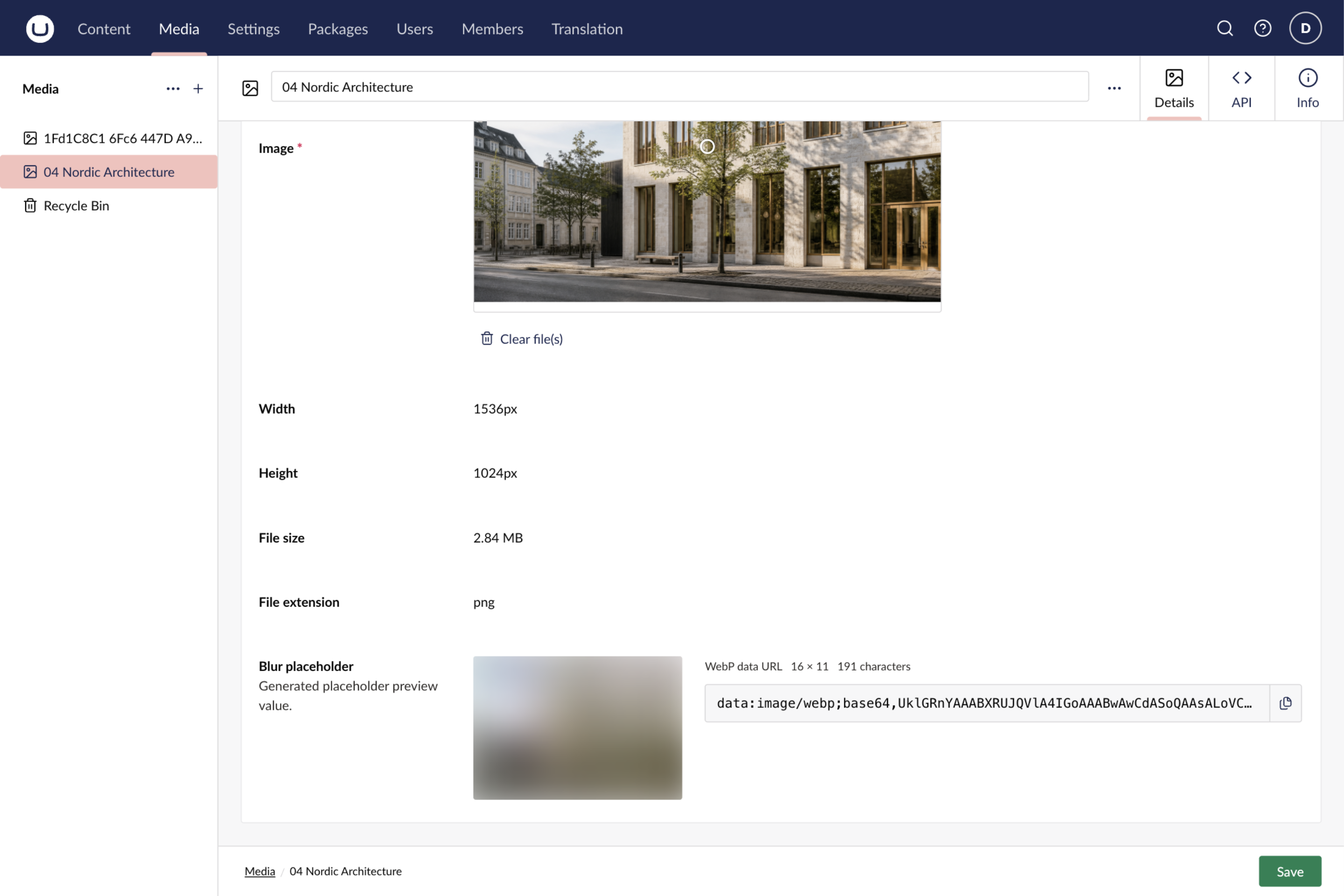
Generated once, stored with the image. No image processing during public requests, no required browser decoder, and no separate placeholder service.
Pick the smallest value your frontend can work with. The default WebP works anywhere an image URL works.
Browser-ready data URL · no decoder required

Compact, configurable native hash

Aspect ratio, color, and alpha metadata
Placeholder generation belongs next to the source image, not in every frontend that consumes it.
Create the placeholder when an Image changes and store it with the media item. Public requests do no image processing.
Process existing images once per output configuration, with resumable maintenance and targeted retries for transient failures.
Opt into blurPlaceholder through the Delivery API and pass the default WebP value straight to your image component.
Request blurPlaceholder explicitly through the Delivery API. The default WebP value can go straight into an image component, while native hashes remain self-describing when a server-side decoder is worth it.
GET /umbraco/delivery/api/v2/media/item/{mediaId}?expand=properties[$all]&fields=properties[blurPlaceholder]{
"name": "Alpine lake",
"url": "/media/n1hbay0t/alpine-lake.jpg",
"properties": {
"blurPlaceholder": "data:image/webp;base64,UklGR..."
}
}Install the package, save an image, and request the generated field only where your frontend needs it.
Focused packages for modern Umbraco projects.

Shows the traffic from Vercel Web Analytics or Plausible in the Umbraco backoffice, for the whole site and for each page.

Reads the C2PA Content Credentials on uploaded images and flags the ones that say they were made or edited with AI.

Lets editors change the next-intl or i18next messages in your app from Umbraco. Your app fetches the changes when it runs.

Lets frontends call the Delivery API and your own endpoints with an OIDC token from their hosting platform, instead of a shared API key.

Shows your Document Types as a city in the backoffice, with the links between them, and flags schema problems before they ship.

Renders the rich text JSON from the Umbraco Content Delivery API with React. You decide how each block and node is rendered.